Showing posts with label Muddy Waters. Show all posts

Wednesday, November 21, 2018

Rolling Stones; older than I am, yet still rockin’ away after all these years

Perhaps this is a tacky joke, but I have to wonder what the fine print says for anybody buying tickets to the Rolling Stones’ upcoming U.S. tour – the one that has them traveling the country come spring and summer, with a Soldier Field stop on June 21.
In fact, Chicago will actually be the final stop on the tour – which creates the potential of a band operating on pure adrenaline. They’re going to have to be outright exhausted by that point in time.

CONSIDERING THAT THE key members of the band that has operated for more than a half-century are aged – rock stars Mick Jagger and Keith Richards both are now 75 years old.

Yet carrying on as though they think they’re still in their early 20s, playing music for the masses and carrying on the image of the late, great bluesman Muddy Waters – whose hit song “Rolling Stone” gave the band their very name.

Now I’ll be the first to admit that at age 53, I’m not capable of the kind of stamina one would need to do such a tour. It kind of astounds me that Richards, of all people, would be capable.

But then again, if someone were willing to pay me the kind of money the Rolling Stones will be getting for these shows, I’d figure a way to get myself up and running so as to do it.
A favorite, particularly the cover

BUT THEN AGAIN, the Rolling Stones seem to be a unique institution, performing those concerts that still draw the kinds of crowds to pack stadiums such as Soldier Field.

Whereas most other rock ‘n’ roll bands of the 1960s who still insist on performing live are reduced to events such as the Ribfest held every summer in suburban Naperville.

Or, like the Buckinghams – the one-time Chicago native band named for the fountain – playing venues such as the Paramount Theater of Asbury Park, N.J. (they really played there back on June 21 of this year).

Although the same purpose was served – allowing aging fans to be able to close their eyes and pretend they’re still youthful. And that with the opening guitar riff of “I Can’t Get No (Satisfaction),” they can pretend it’s still 1964 and that by listening to “the Stones,” they’re making a statement about how much “the Beatles suck!”
TO BE HONEST, though, watching those old video snippets of when the Beatles came to White Sox Park for a pair of concerts back in August of 1965 (just a few days before I was born) makes me think that event was far more significant than any of the Stones’ concerts – since my own quickie research finds they have played here so many times throughout the decades.

The only way the 2019 concert becomes memorable is if, by chance, there is a fatality in the band and the event becomes an informal memorial tribute. A morbid thought that I'm sure no one is rooting for.

But I’m sure the kind of people paying hundreds of dollars to sit in the outer reaches of the Soldier Field seating bowl aren’t going to let anyone deprive them of a musical experience.

And they’re not about to let some snot-nosed 19-year-old punk make rude comments about the Rolling Stones being a batch of geezers. They’re going to enjoy their money.

NOT THAT I have any intention of showing up – mostly because I think it’s impossible to truly capture the essence of what made the Rolling Stones so incredibly unique in musical annals. Time passes us all by, and what we have left are lasting memories.
So that may be the real essence – listening to those Rolling Stones records I have amongst my collection (yes, I did buy the “Blue & Lonesome” compact disc of a couple of years ago). My memories get triggered every time I play a record or disc.

And as far as I’m concerned, I have a personal favorite recording – although not one that would come to many fans’ minds. It’s “2120 S. Michigan Ave.,” the instrumental number on one of their first records meant to be a tribute to the old Chess Records label (which was located at that address).
Which is meant to remind us of the great blues music that once came from that address. Now if Muddy Waters, or any of the great old bluesmen, were to be capable of giving us a concert, THAT might be the concert event worthy of much of the hype the Rolling Stones will try to arouse in coming months.

  -30-

Wednesday, September 14, 2016

Navy Pier losing its carnival-like atmosphere to become a luxury hotel

I enjoy Chicago, take a certain amount of pride in being able to say I was born here and have lived the bulk of my life here. I also think this city is a wonderful place that everybody in the world ought to come to enjoy at least once in their lifetime.
 
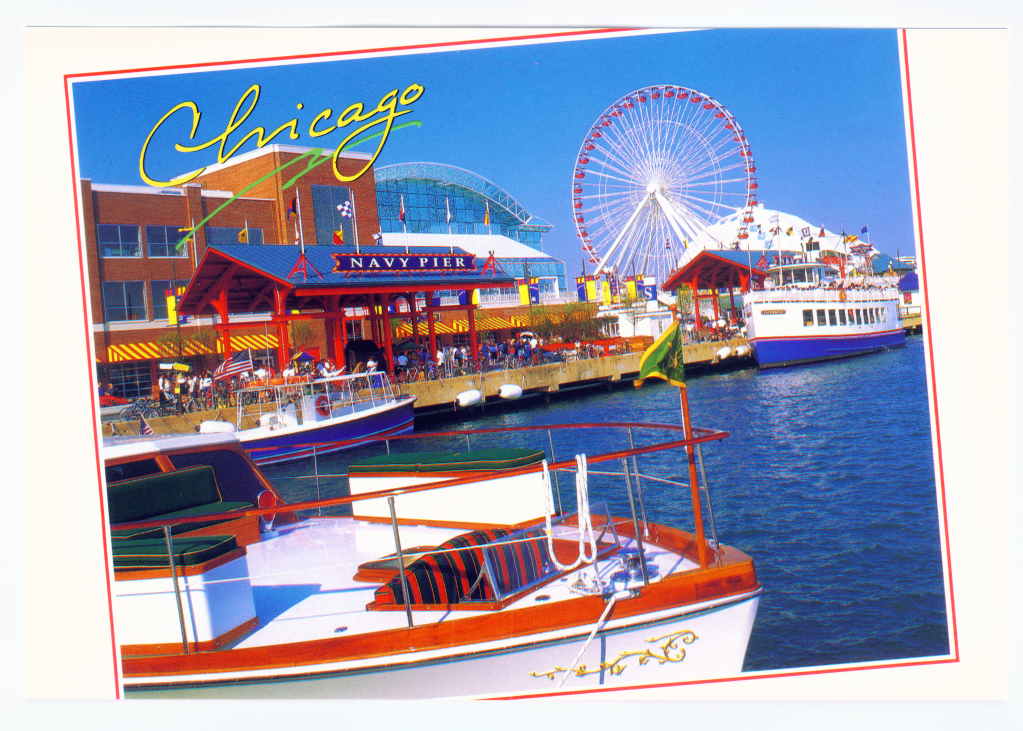
The carnival-like atmosphere at Navy Pier could become a part of the past. Image provided by Chicago Postcard Museum

Yet I have to confess to always feeling a little tinge of embarrassment whenever I read something reminding me that Navy Pier is the Number One tourist attraction not only for Chicago, but for the state of Illinois.

IT JUST SEEMS a little silly, to me, that people who have taken the time and effort to make the journey to Chicago wind up wasting their time checking out the pier, or at least what has become of the pier in the past three decades.

The giant Ferris wheel gave the place a carnival-like atmosphere. And I realize the historic implication of a Ferris wheel in Chicago being reminiscent of the worlds’ fairs that were held in our city.

But if you think about it, you can ride a Ferris wheel anywhere. Admittedly, you won’t get a great view of Lake Michigan at the top of a wheel at some rural county carnival. But a wheel is a wheel.

Even more silly, to me, was that Bubba Gump Shrimp Co. restaurant located at the pier. Created to feed off the popularity of the 1994 film “Forrest Gump, it also is something that seems so absurd. With all the quality dining one could find in Chicago, people would be expected to choose a brand that has 43 locations across the United States, along with Mexico, Great Britain, Malaysia, Japan, the Philippines, Indonesia and Hong Kong.

Navy Pier a long ways from when it was purely a boat-docking facility
IT COMES ACROSS as being a real-life take on the gag from that episode of “The Simpsons” where the family goes to Japan and winds up eating at the “Americatown” restaurant, where mom Marge gets excited about seeing the Japanese take on the club sandwich!

In short, Navy Pier isn’t a place I go to very often (and not just because I’m a cheap grouch!). So I have to admit to feeling a jolt of excitement when I learned this week of the City Council contemplating an overhaul of the place that was erected a century ago as a pier for those ships sailing into Chicago off Lake Michigan.

Which makes the pier’s incarnation of recent years seem so ridiculously absurd. I doubt that those sailors who arrived in Chicago at the pier some 90 years ago, or those people who came to the pier to fish a half-century ago, ever would have envisioned a place that had lots of shops where one could buy various incarnations of a “I (heart) Chicago” coffee mug.

The council’s zoning committee gave its approval this week to a plan calling for a seven-story hotel to be built on the pier, along with amenities such as a winter ice-skating rink, a sloped-roof welcome pavilion (which likely would continue to have all those gift shops selling tacky trinkets) and some short-term boat docking facilities.
The days of academia are long-gone from the pier. Photograph provided by Chuckman Chicago Nostalgia
IT IS, AFTER all, a pier. Which means boats. The people who conceived of the need for a pier sticking out one mile into Lake Michigan didn’t do so because they wanted a unique site for a carnival ride.

Although I also realize that ships transporting goods don’t arrive at Navy Pier anymore. What little shipping still arrives in Chicago sails into the piers down around Lake Calumet.

So I realize that the pier has to evolve, or else become pointless and rot away. Which is the fate it nearly suffered by the late 1970s.

I can remember the days just before the remodeling of the 1990s when the structure was largely vacant and it was obvious that the facility had a very practical purpose for briefly storing goods brought in from ships.

I CAN REMEMBER making the walk to the pier offices at the far east end of the facility, having to go through all the vacant space and feeling like it was such a waste. The ghosts of college students past from the pier’s UI-Chicago days and those from the days when World War I-era draft dodgers were incarcerated there were all over the place.

Plus, I’m also old enough to remember the “Chicagofest” festivities held at the pier that then-Mayor Jane Byrne always liked to think were the biggest part of her legacy to the city. Closing my eyes could bring to mind memories of seeing Muddy Waters perform there, along with the Turtles (remember “Happy Together?!?”).

Losing some of the sillier touristy aspects of what has become Navy Pier will be a plus – particularly if it provides a facility that can enhance Chicago as a whole.

That used to be a long walk, particularly when made on a cold December day. Photograph provided by Chuckman Chicago Nostalgia
Although I suspect I still won’t become a Navy Pier regular, because I think that whatever hotel winds up being built at the site will be one I won’t stay at because it will wind up far beyond my own income level.

  -30-

Monday, July 16, 2012

A ‘blues’ museum on Block 37? They might as well bring back the ice rink

I like the idea of museums, particularly when they pay tribute to something that so many of us know little about.

I also do not have a knee-jerk reaction against real estate developers. And I appreciate just how harmful the story surrounding “Block 37” has been to Chicago’s public image.

HAVING WRITTEN ALL that, let me also say that I think the idea of a museum devoted to telling the story of blues music to be built right in the heart of downtown Chicago (in the block just east of the Daley Center) could well be one of the dumbest ideas this city has ever contemplated.

Somehow, the idea of paying tribute to musicians such as Muddy Waters by erecting something in the heart of the downtown shopping district strikes me as being more oriented toward selling t-shirts – rather than telling the real human stories of the musicians who gave us the blues.

This is musical form where commercialism of any sorts can only trivialize the art form.

And I just can’t help but think that putting a “blues” museum on Block 37 would create a place that would have repulsed the real-life blues artists – even if I’m sure many of them would gladly have accepted any cash that would be generated by such a place.

KEEP IN MIND that I personally love listening to the blues – and I don’t mean rock ‘n’ roll with a heavy blues beat. Anybody who thinks that Eric Clapton is a bluesman, or that there was anything musically intriguing about the Blues Brothers, is probably the kind of person who would like a downtown Chicago blues museum.

They probably also enjoy the “set list from Hell” asked of too many blues musicians these days – the same dozen or so songs that invariably asks for “Sweet Home, Chicago” to be played as an encore.

I enjoy hearing that song every now and then, and will gladly put on my recording of it as performed by Magic Sam. Anybody else is just stunting the blues as a musical form when they try to play it – note for note – as Sam did. And yes, I know that it was Robert Johnson (who really deserves to be labelled as "God" rather than Clapton) who originally came up with the song.

I also believe that a downtown museum would wind up reinforcing those forces that have turned blues music into a musical museum-piece, rather than a thriving musical form being passed along throughout the generations.

TOO MANY WHITE people merely think of the blues as overly-intense guitar solos, while too many black people think of the blues as the music their great-grandparents listened to way back in the days of segregation.

Which is a shame!

Because when it comes to a recording that can make the hair on the back of my neck stand on end, I’d say it is Elmore James’ performances of “Dust My Broom.”

There’s something about that guitar intro that is so eerie, yet all powerful. And even though I can match it note-for-note when I play my own guitar, mine sounds like a lame copy.

WHICH IS WHAT I would think of a downtown-based blues museum erected on a city block with a shopping center that is trying to be so upscale. It would be such a gross mismatch that the only people I could see going there would be tourists who literally wouldn’t know any better.

That is a real shame. Because the idea of a blues museum ought to be to inform the public about the music – not to spread a distorted, overly watered-down, form.

If there is to be a museum devoted to the blues, it probably is something that has to go in one of the neighborhoods of the great South Side – the place where such music was once the daily noise that could be heard coming from tavern after tavern.

Along with flat after flat from buildings in the Bronzeville neighborhood that once had way too many people jammed into them because the “establishment” didn’t want all those African-Americans living elsewhere – an attitude that spilled over into the music.

SUCH A MUSEUM could even wind up being an attraction to try to get people to visit those areas, and could help bolster their own economic development. If anything, it is why I respect the idea that some officials are trying to develop a museum to tell the story of gospel music.

The proposed Chicago Gospel Music Heritage Museum is scheduled/expected/desired to open by October at the one-time Pilgrim Baptist Church at 33rd Street and Indiana Avenue – the place where such religious-inspired music allegedly was created.

Maybe the site of the one-time Checkerboard Lounge on 47th Street is a blues museum site possibility. I don’t know.

All I do know is that Block 37 seems like a stretch for such a facility. And if that’s the best idea that developers can come up with, then maybe we’d be better off if they just brought back that ice skating rink they used to erect every winter in the heart of downtown.

  -30-

Friday, June 5, 2009

Taylor a throwback to old Chicago

I saw blues singer Koko Taylor perform several times during my life, but the occasion I recall most vividly occurred in a place far removed from the South Side atmosphere that her rough, rugged voice brought to mind.

It was at Illinois State University, the Normal-based college that was within walking distance of my own alma mater – Illinois Wesleyan. Back in what was most likely 1984, Taylor and her Blues Machine band was earning a living performing the blues, and they gave a concert on the college campus.

WHAT MAKES THAT event stick so strongly in my mind is the fact that I literally got a front row center seat. I was probably about 10 feet away from her in what was a packed (several hundred, maybe up to 1,000 people) hall of people whose idea of a study break was to spend a Saturday night listening to Koko giving us her take on “Wang Dang Doodle” and other blues songs.

Now I don’t listen to the blues as much as I used to back in college. I still have all my old LPs of Taylor’s music, but the most recent recordings on CD are ones I haven’t gotten around to buying yet.

But back in the days when I did manage to blow much of my spare cash on music and recordings, I remember that a Koko Taylor record was always more valued than some of the other stuff that passes for blues these days.

I still own some of my old vintage recordings of music by artists such as Muddy Waters, Magic Sam and B.B. King (who once gave us a recorded concert performed from our very own Cook County Jail).

BUT THERE WAS always a difference between listening to something like “I Just Wanna Make Love to You” by Muddy Waters, and anything recorded by someone like “Lil Ed and the Blues Imperials.”

Whether it was in the writing of the songs or just the fact that so much of life and our society has changed that no one could possibly come up with a song like “Hoochie Coochie Man” these days, the modern-day “bluesmen” all too often sound like a parody of the real thing.

Too much worried about getting the right “sound” to their guitar solo, rather than trying to catch the earthy feeling that is what makes the blues legitimate.

That is what always, to my ear, made Koko Taylor unique.

THE LADY FROM Tennessee who followed the migration of black people from the South to the South Side and who once was the cleaning woman for rich white people (who probably had no clue of her “night” job and its cultural significance) was one of the few blues singers I ever heard who had a sense of the real earthy feel that used to be heard in clubs all throughout Bronzeville some 70 years ago.

None of the guitar-oriented nonsense that can overwhelm a true blues singer, which at its best should be some of the simplest music played.

And definitely none of that bleached out sound that too often comes from listening to white rock ‘n’ roll types trying to play the blues because they like the guitar sound.

I’d rather hear Muddy Waters any day than any of the cover versions recorded back in the 1970s by Led Zeppelin or Eric Clapton – even though I know of people who feel just the opposite (they view the newer versions of the songs as “polished and improved” versions – I say they’re nuts).

THE WORST PEOPLE, in this regard, are the ones who think that “the Blues Brothers” film had anything to do with blues music. My reason for getting into that film is seeing the grittiness of a now-gone Chicago on film. The music itself is too pop oriented at times.

No one would ever call Koko Taylor’s music polished or pop. And that was its beauty.

What made her special is that she was still with us even into the 21st Century, giving us a taste of what used to echo from clubs along East 43rd Street (the old Checkerboard Lounge) back in the first third of the 20th.

Plus, she was still in her prime physically until recent years. So we got to hear the earthiness of the blues at its best.

THAT WAS PARTICULARLY rare. I can claim to have seen both Muddy Waters and John Lee Hooker perform live. But by the time I saw them in the 1980s, they were old men who didn’t sound anything close to what they were in their prime.

Seeing Hooker, in particular, was like listening to one of those oldies revival tours, with bands such as the Buckinghams trying to pretend they can turn the calendar back some 40 years. In Hooker’s case, he was trying to go back about 60 years, and it wasn’t convincing.

It made me wish I could have seen him in his prime. But in the case of Koko, I got to see and hear her in her prime.

Those occasions will be among the moments I recall of an older Chicago likely for the rest of my life.

NOW EXCUSE ME while I walk over to my turntable (I still own a functioning one) and put on my copy of “Queen of the Blues.” (And I don’t want to hear arguments about how I ought to own the CD instead).

At this particular moment (which is about one day after I first learned Taylor died following complications from surgery performed a couple weeks ago), I think I need a jolt of “Queen Bee” to brighten my day.

-30-

EDITOR’S NOTE: Listen and learn for yourself about the musical career of the late (http://www.kokotaylor.com/index.html) Koko Taylor.